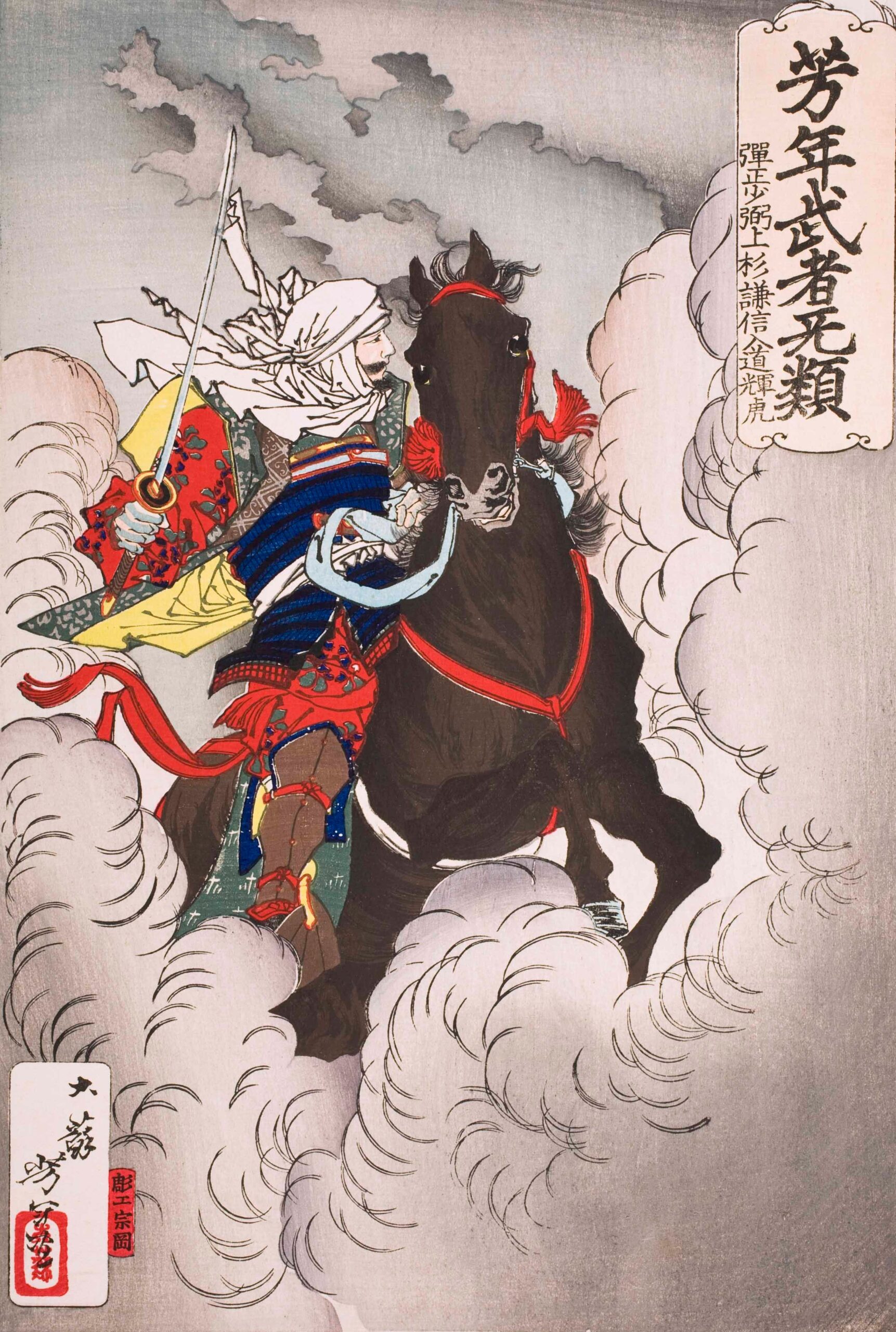
When people imagine the legendary warriors of Japan’s Sengoku period, one name consistently stands out: Uesugi Kenshin, the “Dragon of Echigo.” Known for his tactical brilliance, fierce sense of honor, and almost mystical aura, Kenshin remains one of the most fascinating military leaders in Japanese history.
The dramatic ukiyo-e scene above—originally created by the master artist Tsukioka Yoshitoshi—captures the intensity and dynamic power often associated with Kenshin. Charging forward on horseback, sword drawn and determination unwavering, he embodies the archetypal warrior-lord that history enthusiasts love.
In this article, we explore the life, character, and legacy of Uesugi Kenshin—and why he continues to captivate Sengoku fans around the world.
Who Was Uesugi Kenshin?
Uesugi Kenshin (1530–1578) ruled Echigo Province (modern Niigata) and rose to prominence as one of the most formidable daimyo of the era. His reputation came not only from his battlefield victories but also from his strict adherence to a warrior code that emphasized justice, fairness, and discipline.
While many warlords sought territorial expansion above all else, Kenshin positioned himself as a protector—especially of the oppressed and of trade routes threatened by bandit clans and rival domains.
A Rivalry for the Ages: Kenshin vs. Takeda Shingen
Kenshin’s legendary rivalry with Takeda Shingen is often described as the Sengoku equivalent of “hero vs. hero.” Their five clashes at the Kawanakajima plain remain some of the most studied battles in Japanese military history.
A few reasons this rivalry still captivates fans:
- Evenly matched strategies: Shingen was a master of cavalry and logistics, while Kenshin excelled at sudden strikes and fluid battlefield maneuvering.
- Mutual respect: Kenshin famously sent Shingen salt during a political embargo, saying, “I do not fight with salt, but with the sword.”
- Iconic duel: Legends describe Kenshin charging directly at Shingen on horseback during one battle, striking at him with his sword while Shingen blocked with a war fan.
These stories helped elevate both men into the realm of myth.
The Warrior-Monk Aura
Kenshin’s spiritual devotion makes him especially unique among Sengoku warlords. He worshiped Bishamonten, the Buddhist god of war and righteous defense, and some believed Kenshin to be an earthly manifestation of the deity himself.
This connection deepened his image as a warrior driven not by greed, but by purpose—a rarity in a time defined by ambition and betrayal.
Why Uesugi Kenshin Still Fascinates Fans Today
For Sengoku-era enthusiasts, Kenshin is the perfect blend of:
- Military genius
- Personal honor
- Strategic unpredictability
- A near-mythical aura
He continues to appear in novels, games, historical dramas, and artwork because he represents the ideal of the noble warrior—a figure who wins not only battles, but admiration.
Ukiyo-e Art and Kenshin’s Visual Legacy
The ukiyo-e image you see here reflects how artists of the Meiji period viewed Kenshin: dynamic, fierce, and heroic. The swirling smoke, galloping horse, and flowing garments amplify his momentum—almost as if he’s breaking through the confines of the print itself.
For history fans and collectors, artwork like this offers more than visual beauty; it provides insight into how later generations mythologized Sengoku heroes.
Final Thoughts
Uesugi Kenshin’s legend continues to grow centuries after his death. Whether you admire him for his strategies, his rivalry with Takeda Shingen, or his principled approach to warfare, Kenshin stands as one of the Sengoku period’s most compelling figures.
If you’re passionate about samurai history, battle strategy, or Japanese art, diving deeper into Kenshin’s world promises an exciting journey.
Leave a Reply